
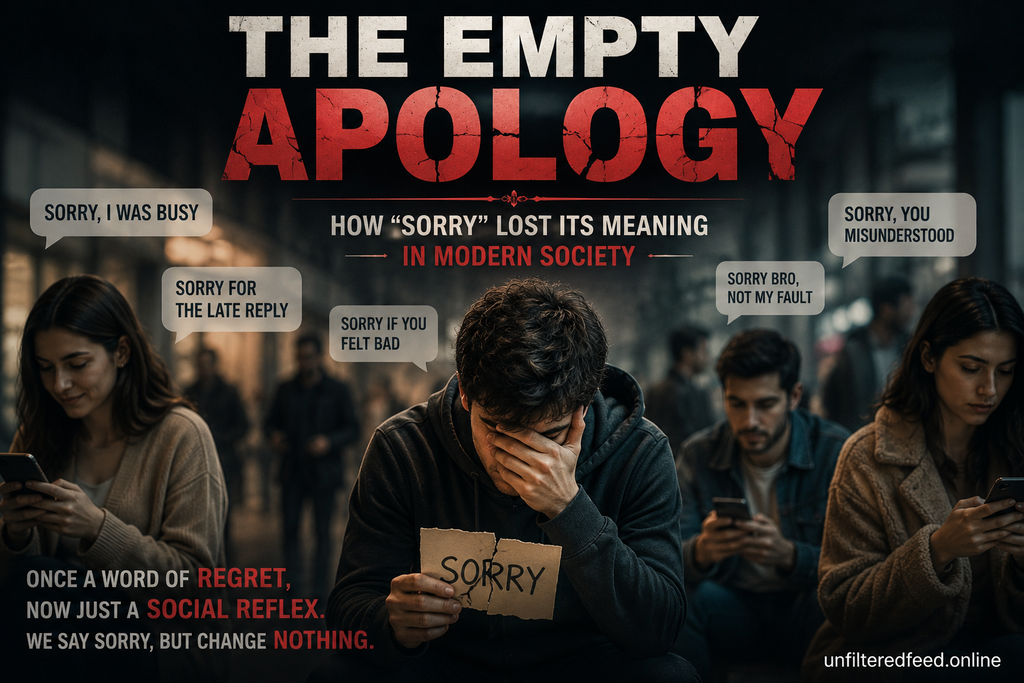
Introduction
The topic I am raising today addresses a quiet yet alarming crisis in our social interactions Empty Apology; the devaluation of forgiveness. Forgiveness is not merely a word we utter; it carries an entire world of healing within it. Truly forgiving someone for a mistake, an oversight, or the emotional pain they have inflicted requires genuine empathy and depth of character.
Unfortunately, in today’s society, we have reduced this profound virtue to a superficial routine. We casually throw around the word “sorry,” yet behind that label lies a growing hypocrisy. On the outside, we pretend to move past grievances, but on the inside, we harbor lingering bitterness. We have learned to mask our true feelings, acting like polished, agreeable individuals on the surface while secretly holding onto resentment; resembling a beautifully disguised monster within our relationships.
1. When “Sorry” Held a Universe within It
If we were to ask our parents or elders what a genuine apology meant in their time, we would realize how much weight that single word carried. Back then, “sorry” was not a casual statement; it was a deeply meaningful act. When someone committed a mistake or spoke harsh words, admitting fault and asking for forgiveness was seen as the ultimate gesture of humility and respect. A sincere expression of regret was enough to heal wounds and restore trust, serving as the strongest foundation for lasting relationships.
Our elders lived by the wisdom that loved ones can never truly be detached from one another; just as fingernails cannot be separated from the skin. This core belief kept families, siblings, parents, children, and friends firmly bound together. An apology meant a promise: an assurance that the mistake was recognized, genuine remorse was felt, and it would not happen again. There was an innocent purity in forgiving and moving forward without holding a grudge.
“In the past, an apology was a bridge that brought hearts closer; today, it has become a shield used merely to end a conversation.”
2. The Modern Youth and Fake Forgiveness: A Deeper Hypocrisy
In 2026, our generation has reduced the concept of an apology to a mere formality. “Sorry” has lost its gravity; it is tossed around without any real weight or remorse. Today, even when an apology is accepted on the surface, true forgiveness is rarely granted. If a friend hurts or betrays someone and says “sorry,” the response is often a polite “It’s fine,” but behind closed doors, the stance shifts to: “I can never forgive them; seeing them just reopens my wounds, but I’m maintaining ties out of necessity.”
I recently met a girl who shared a harsh yet revealing perspective. She said, “What is the point of saying sorry after breaking someone’s heart? If an apology could truly heal emotional wounds, we wouldn’t need doctors.” This mindset reflects how our youth has turned forgiveness into a form of passive hypocrisy. We accept apologies out of societal obligation or to keep up appearances, while holding deep-seated bitterness on the inside; acting with a double face.
In reality, true forgiveness requires high moral character (Ahl-e-Zarf), which many lack today. Instead of genuinely forgiving and letting go, people hold grudges and pass judgment onto the Divine, using “Allah will deal with them” as a cover for their own unwillingness to heal.
The Islamic Perspective
Islam teaches that true nobility lies in forgiving others unconditionally, rather than harboring silent hostility. Allah praises those who suppress their anger and pardon people:
“Those who spend [in the cause of Allah ] during ease and hardship and who restrain anger and who pardon the people – and Allah loves the doers of good.”
Frequently Asked Questions (FAQs)
Q1: Why has the word “sorry” lost its value in modern relationships?
A: Because it is often used as a quick escape or a polite formality rather than a genuine admission of guilt. When an apology lacks real remorse and behavioral change, it becomes a empty phrase rather than a tool for healing.
Q2: What is the difference between superficial forgiveness and true forgiveness?
A: Superficial forgiveness happens when someone accepts an apology on the outside to keep the peace, but continues to harbor resentment within. True forgiveness involves letting go of the anger, healing emotional wounds, and freeing oneself from bitterness.
Q3: Is it wrong to feel unable to forgive someone immediately after being hurt?
A: Healing takes time, and instant forgiveness isn’t always realistic. However, pretending to forgive while secretly holding a grudge creates hypocritical relationships. It is healthier to take time to process emotions than to give a fake “it’s okay.”
Q4: How does holding onto grudges affect our mental well-being?
A: Carrying unexpressed anger and fake acceptance drains mental energy. Forgiveness is ultimately for your own peace of mind; it allows you to release emotional burdens and live with a clean heart.
- Why does society dismiss a woman’s Decisions?
- How social media frauds and Scams are destroying our lives
- Women as the First Protector and Guardian Angel on Earth for Their Children
- The unseen reflection: Why we judge others and are judged ourselves from others
- The illusion of unlawful Affection: Why Real peace cannot found in what Islam has forbidden
Pingback: How Social Media Is Making Us Run in the Race of This Temporary World
Pingback: Why does Human Nature hold fear?